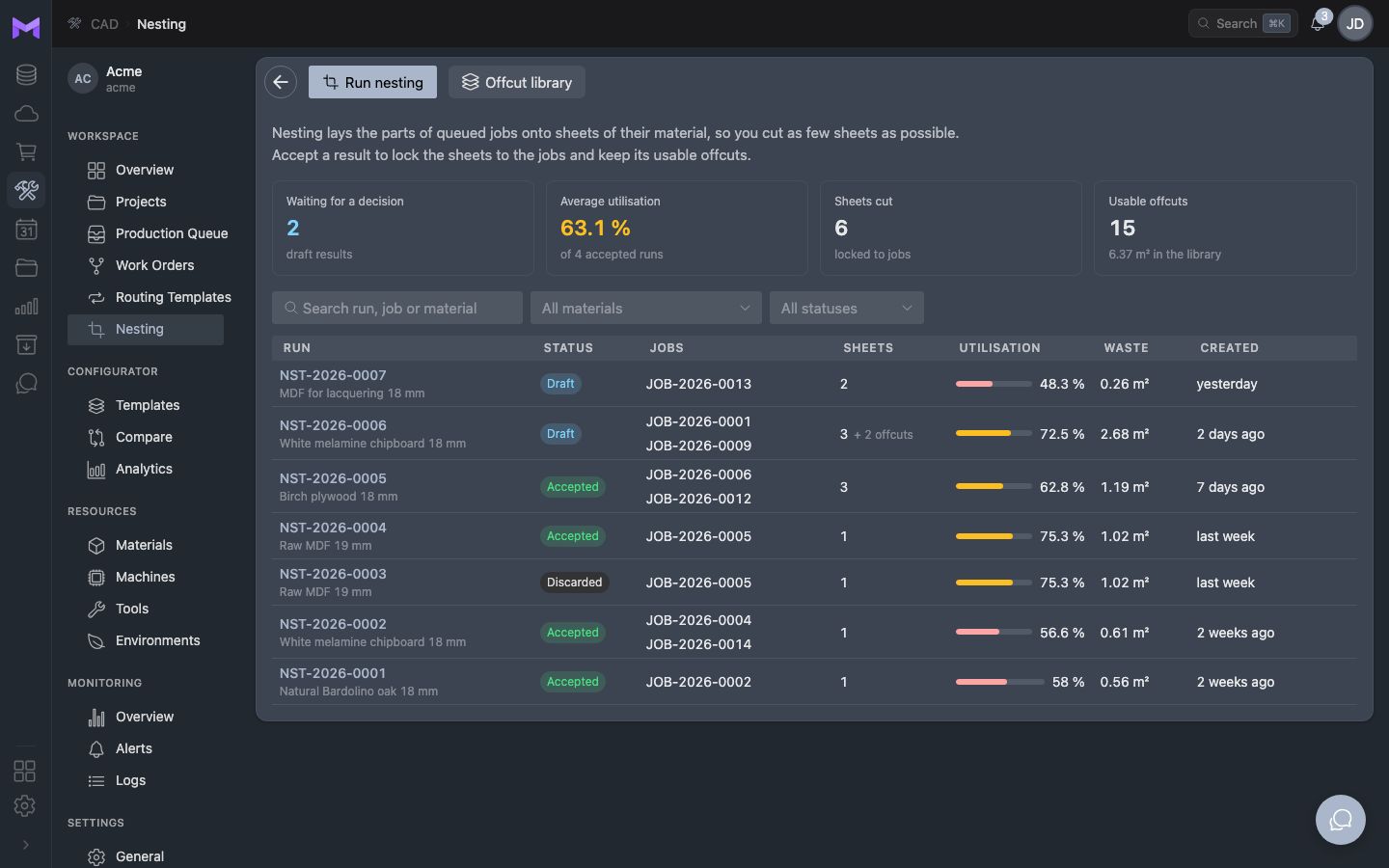
You sell parts, but you buy boards. What you pay for an order depends on how many boards it takes, and that depends on how the parts are laid out on them. Laying them out well is called nesting, and it is one of the few savings in a workshop that costs nothing but thought.
Parts on boards
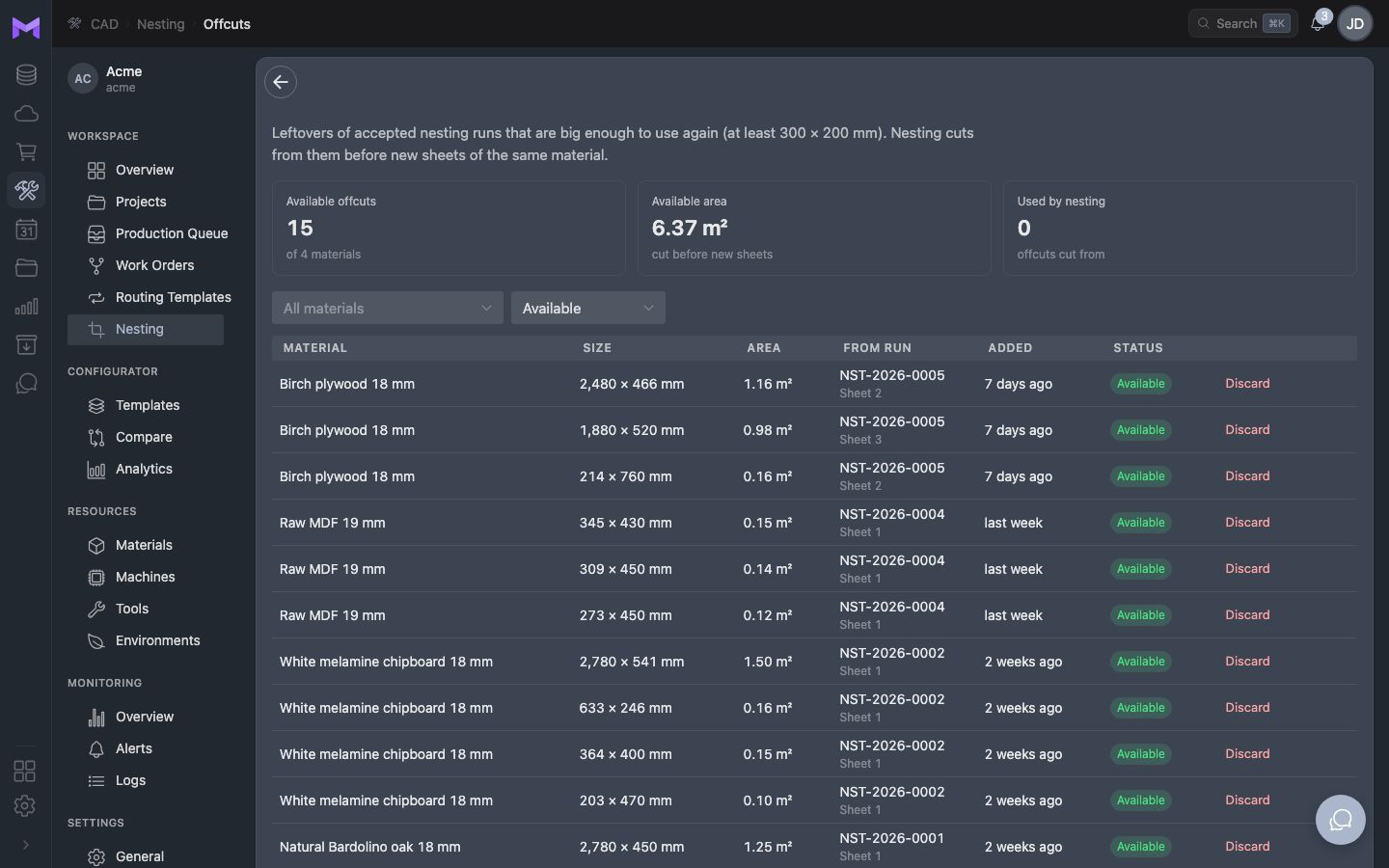
Nesting is placing the parts of one or more orders on full boards so that as few boards as possible are cut. The eight parts of a small cabinet, from sides to doors, fit on one board of 2800 × 2070 mm and use about half of it. The rest is offcut: some of it big enough to keep, some of it waste.
Where the saving comes from
The same parts can take one board or two, depending on their order and how they turn. Nesting finds the layout that fills each board before starting the next.
- Mixing the parts of several orders on the same boards
- Turning parts where the grain allows it
- Keeping large offcuts as stock for the next small parts
- Counting the saw kerf and the edge trim, so the plan fits the real board
What limits it
A panel saw cuts right across the board, so its layouts are built of strips. A CNC router can place parts more freely and nests tighter. Grain limits it too: a part that must follow the grain cannot turn to fill a gap. Each limit costs some board, and it is better to know how much than to guess.
Price the board a part really uses
Once you know how a part lies on the board, you can price what it really takes: its own area, plus its share of the waste around it. That is fairer to the customer who orders one large part, and it keeps the price of small parts honest.
Try it on your own parts
Type the parts of a job you know and see how many boards they need, how full each one is, and which offcuts are worth keeping. Compare it with what you cut last time.